


For much of 2026, the message for taxpayers with discretionary trusts has been simple – wait before you act.
That wait is now coming to an end. The starting point is no longer, “Should I wait?” It is, “Which option is best for me?”
The legislation introducing the 30% minimum trust tax has now passed both Houses of Parliament and is awaiting Royal Assent. While the measures will not become law until Royal Assent is received, we now have significantly greater clarity about the rules that will apply. The 30% minimum trust tax is due to commence from 1 July 2028, while transitional restructuring opportunities will become available from 1 July 2027.
There are four main paths to consider. None is perfect and, perhaps surprisingly, doing nothing may still be the right answer for some taxpayers.
Choosing between the options is about more than finding the lowest tax rate. Tax efficiency needs to be weighed against future income levels, flexibility, asset protection, privacy, succession plans, the Capital Gains Tax (CGT) changes and the cost of changing structures. What matters most will be different for every family group. The important thing is to consider your personal circumstances and understand which of the options below may work for you. Further, if you control more than one trust, the decision may be different for each trust.
Our recommendation is to speak with your advisor and lock in a time to review your structure. There is still time to make considered decisions, but as the commencement dates approach, that time will become increasingly valuable.
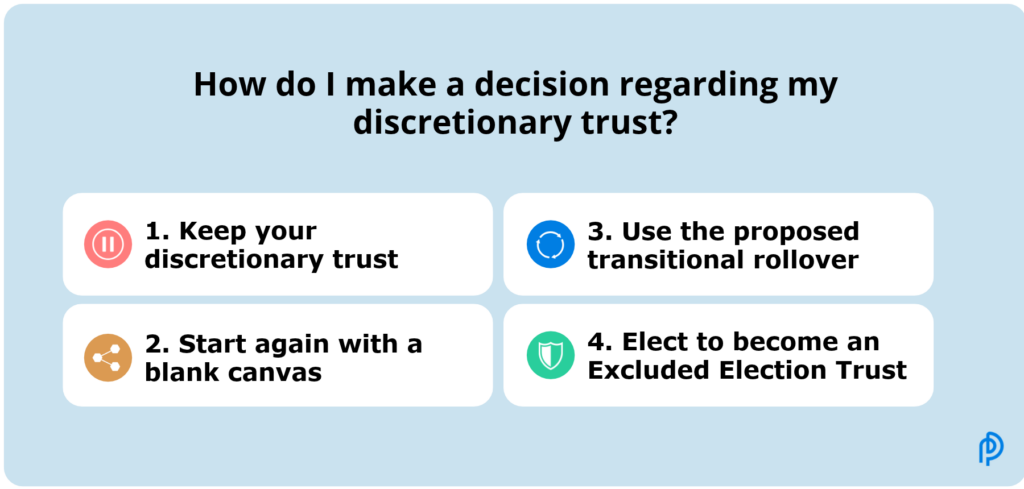
We explore the four options below.
Option 1: Keep your discretionary trust
For some taxpayers, paying the proposed 30% minimum trust tax may be an acceptable outcome.
Keeping the discretionary trust is likely to be more attractive where distributions are already being made to individual beneficiaries whose marginal tax rate means the proposed 30% minimum trust tax produces little or no additional tax cost. For example, this may be the case where individual beneficiaries already have sufficient taxable income from other sources, or where their trust distributions are large enough that their effective tax rate is already around or above 30%. The relevant thresholds will depend on the tax rates applying in the income year.
Importantly, the 30% rate is a floor, not a ceiling. The appropriate structure therefore needs to be considered against both the trust’s current income and what that income may look like in the future. If trust income is significant, or is expected to increase significantly, retaining the existing structure may become less attractive as more income is distributed to individuals at higher marginal tax rates.
Corporate beneficiaries require particular attention. Many discretionary trusts currently distribute income to a corporate beneficiary to cap the initial tax payable at the corporate tax rate of 25% or 30%. Under the proposed rules, that strategy may no longer produce the same outcome. Distributions to corporate beneficiaries can result in effective tax rates exceeding 60%, meaning a trust that uses a corporate beneficiary as part of its existing tax strategy may consider an alternative option. Accordingly, the decision to retain a discretionary trust should consider not only the amount of income the trust generates, but who that income is expected to be distributed to and how the funds are ultimately used.
Keeping the discretionary trust means retaining its high level of flexibility, asset protection and privacy, while also preserving existing grandfathered CGT concessions. There is no need to transfer assets, so there would generally be no valuation requirement, transfer duty exposure or restructuring costs simply from retaining the existing structure.
Finally, if you consider that we will get a change of government with sufficient sway in both houses of parliament before July 2028 to ‘axe the tax’, this option may be for you.
For the right taxpayer, doing nothing isn’t failing to act. It may be the option that best preserves what the discretionary trust was established to achieve in the first place.
Option 2: Start again with a blank canvas
For other taxpayers, the proposed changes create an opportunity to step back and ask a different question: If I didn’t have my existing discretionary trust structure, how would I structure my affairs today based on the current legislative and commercial landscape?
This option may suit taxpayers who are prepared to make a bigger structural change and want maximum freedom to design their future ownership structure, rather than being constrained by the conditions attached to the proposed rollover and discretionary trust changes.
That freedom comes at a cost. The question is whether the long-term commercial and tax benefits justify the upfront tax, duty and implementation costs of starting again.
Transferring assets outside the proposed transitional rollover rules may trigger CGT, subject to any relevant rollovers and concessions, and transfer duty may also apply depending on the assets and jurisdiction. The replacement structure also needs to meet the taxpayer’s requirements for asset protection, privacy, flexibility and tax efficiency. Simply moving the assets into a company may not achieve all those objectives, particularly once the ownership of the company’s shares is considered.
A restructure of this nature is also likely to require valuations of the assets being transferred, together with legal, tax and implementation costs. This means the blank-canvas option is likely to be most attractive where the long-term benefits of getting the structure right outweigh the upfront cost of getting there.
Option 3: Use the proposed transitional rollover
What if you want to restructure, but the CGT cost of transferring assets makes a blank-canvas restructure unattractive? This is where the Government’s proposed transitional rollover may be valuable, but the longer-term consequences need careful consideration.
For a three-year period commencing 1 July 2027, eligible taxpayers will be able to restructure from discretionary trusts into certain alternative structures while deferring CGT that would otherwise arise on the transfer, subject to meeting particular conditions. This option may therefore suit discretionary trusts holding assets with significant unrealised capital gains, where crystallising those gains would otherwise make restructuring prohibitively expensive. However, the immediate benefit of deferring CGT needs to be weighed against the potential loss of valuable grandfathered access to the 50% CGT discount. Depending on the assets held and how long they are expected to be retained, that longer-term cost could outweigh the benefit of the rollover.
Additionally, under the transitional rollover you don’t get a completely blank canvas. To access the rollover, the restructure needs to remain within the specified parameters. This can mean accepting less future flexibility and potentially poorer asset protection than the existing discretionary trust provides.
Importantly, the CGT rollover relief does not mean the restructure is cost-free. Transfer duty may still apply, valuations may be required and there will be professional and implementation costs associated with moving the assets.
Whether the transitional rollover will ultimately be attractive will therefore depend on the circumstances. For some taxpayers, deferring a substantial CGT liability may make restructuring possible. For others, giving up grandfathered CGT treatment, together with the limitations and costs of the rollover, may mean the better option lies elsewhere.
Option 4: Elect to become an Excluded Election Trust
The final option may be attractive for taxpayers who want to retain their existing discretionary trust without being subject to the proposed 30% minimum trust tax.
Under the proposed Excluded Election Trust (EET) rules, the discretionary trust nominates the beneficiaries who may receive future distributions for the purposes of the election. Provided distributions are made in accordance with the election, the 30% minimum trust tax would not apply. Importantly, the election does not require the discretionary trust to restructure or formally restrict the trustee’s discretionary powers.
As the existing discretionary trust and its assets remain in place, an EET may preserve privacy and existing grandfathered CGT treatment while avoiding the transaction costs associated with transferring assets. Asset protection is less certain. While the trust remains discretionary and the trustee must continue to perform its trustee duties, it is not yet clear how the nomination of beneficiaries and operation of an EET may be treated for asset-protection purposes outside the tax law. The trade-off is therefore retaining the existing structure and its tax benefits, while accepting reduced flexibility over who benefits from the trust in the future.
An EET may be particularly attractive where intended beneficiaries and succession plans are already relatively settled, including for taxpayers later in their working life. It may also warrant consideration where distributions to a corporate beneficiary continue to form part of the group’s longer-term strategy.
The expected remaining life of the trust is therefore important. An EET may be better suited to a trust with a relatively short or clearly defined future, where there is reasonable certainty about who should benefit. For a trust intended to continue across generations, committing today to its future beneficiaries may be a much more significant limitation.
While an election can be revoked, the proposed law includes consequences where an election is revoked or its requirements are not met. The election should therefore not be viewed simply as an easy way around the 30% minimum trust tax.
Importantly, an EET is a tax concept and does not replace the trustee’s broader obligations under trust law. The trustee will need to continue to properly exercise its discretion and consider the relevant beneficiaries of the trust when making distribution decisions, including whether distributions made under the EET remain appropriate for the beneficiary group. Maintaining appropriate trustee governance, documentation and decision-making will therefore remain important throughout the life of the election.
The real question is whether retaining the existing structure and not being subject to the 30% minimum trust tax is worth giving up some future flexibility and taking on the ongoing requirements of the EET regime.
What should you do now?
There is no universal right answer for every discretionary trust.
The right option will depend on how you weigh the same key factors: future flexibility, asset protection, privacy, tax efficiency, current and expected future income levels, the implications of the CGT changes and the cost of change.
What has changed is the level of certainty. With the legislation now passed by both Houses and awaiting Royal Assent, taxpayers can start making these assessments against a much clearer legislative framework.
The 30% minimum trust tax is due to apply from 1 July 2028, while the three-year transitional rollover period commences from 1 July 2027. The fact that the tax itself is still some time away should not be mistaken for a reason to postpone the review.
Some decisions will require modelling different structures, obtaining valuations, considering duty and CGT consequences, reviewing trust deeds and succession plans, and potentially implementing substantial structural changes. Those decisions are better made with time on your side.
Now is therefore the time to speak with your advisor, understand the alternatives and, if appropriate, lock in a time to review your structure. The decision does not need to be rushed, but the planning should start.
Contact Pilot
If you would like assistance with your structure review or have questions regarding any of the above options and how they may apply to you, contact Kylee Smith or your Pilot advisor on (07) 3023 1300.